Imago Printer
Choosing between flatbed and rotary printers is crucial for businesses aiming to optimize production efficiency. Both printer types serve distinct needs and offer unique advantages. According to a recent market report, the global flatbed printer market is expected to grow by 6.5% annually, reflecting rising demand in various sectors such as packaging and textiles. Conversely, rotary printers have long been favored in the publishing and labeling industries, showcasing their capability for high-speed output on continuous rolls.
Understanding what is the difference between flatbed and rotary printers can help businesses make informed decisions. Flatbed printers excel at handling rigid materials and complex designs, while rotary printers are known for their efficiency in large-volume printing tasks. These distinctions become essential when considering production costs and turnaround times.
However, companies must consider specific needs and potential challenges. Flatbed printers can be costly due to their advanced technology and often require extensive training for optimal use. On the other hand, rotary printers might struggle with intricate graphics or non-standard materials, which could lead to wasted resources. Therefore, businesses must carefully evaluate their printing requirements and the implications of their choices on project outcomes.
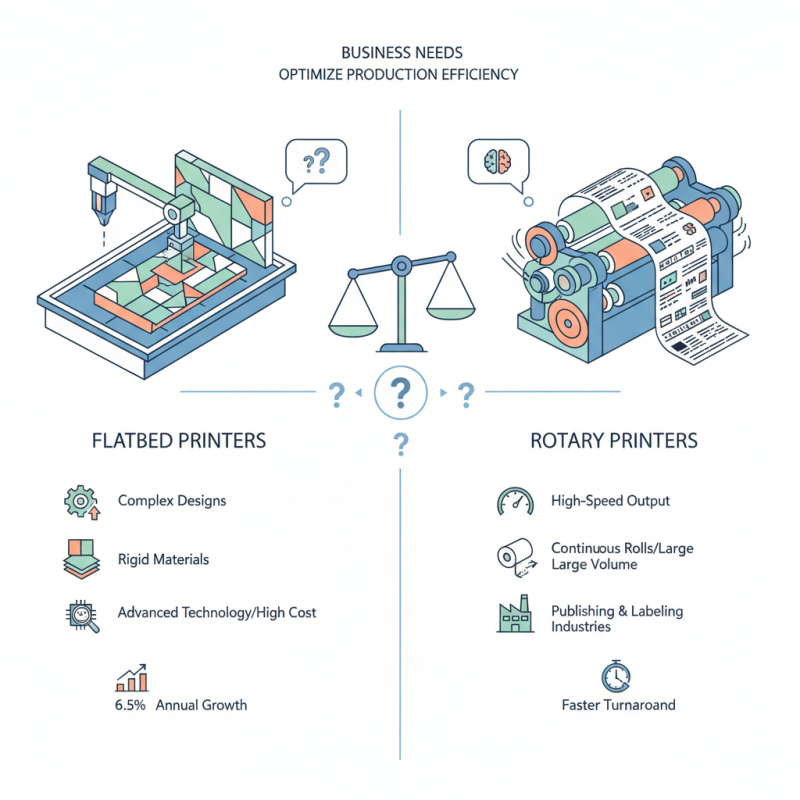
Flatbed and rotary printers serve different purposes in printing technology. Understanding these differences is crucial for making the right choice. Flatbed printers utilize a stationary printing surface where materials are placed. This allows for high-resolution images and detailed prints. They excel with thick materials like wood and metal. On the other hand, rotary printers feature a cylindrical surface. They are designed for high-volume printing, ideal for roll-based materials. This makes them suitable for textiles and packaging.
Tips for choosing the best printer for your needs: Assess the materials you intend to print on. If they are varied, a flatbed printer might be better. If consistency in size and volume is key, consider rotary options. Also, think about the quality of prints. Flatbed printers typically offer more detail.
Consider your production goals. If you often print large batches, rotary printers can save time. However, their setup can be complex. Flatbed printers may require more adjustments for different materials. Be prepared to invest time in understanding your equipment. Explore both options to see what works best. Testing with sample prints can provide insights into capabilities and quality.
When evaluating print quality in flatbed and rotary printing technologies, it's essential to recognize their distinct characteristics.
Flatbed printers excel in versatility. They accommodate various materials, including wood and metal, producing vibrant colors. However, users often find that their resolution can lack consistency across different substrates. A report from Smithers Pira in 2022 indicates that flatbed printing generally maintains a resolution range of 600 to 1200 DPI. This level suits many applications but might not meet the demands for highly detailed images.
On the other hand, rotary printing is known for its high-speed production and superior consistency. This technology is typically used for long runs. A study from the Printing Industries of America revealed that rotary printers could achieve a resolution surpassing 2400 DPI. This makes rotary advantageous for projects requiring sharp text and intricate designs. However, rotary printing often lacks flexibility when dealing with unconventional materials. This can limit project scope, and those requiring bespoke designs may find this to be a significant drawback.
In practice, both technologies have strengths and weaknesses. It’s clear that understanding specific project needs is vital. Print quality, medium type, and production speed should be carefully weighed. Engaging with multiple expert reviews will provide deeper insights into the right choice for any given situation.
When choosing between flatbed and rotary printers, a cost analysis is essential. Flatbed printers typically have higher initial investments. They are versatile, handling various materials. However, their operational expenses can be substantial. Maintenance costs can add up due to frequent use. Users might encounter issues with component wear and tear.
On the other hand, rotary printers usually have lower initial costs. They excel in continuous printing runs, making them cost-effective for large volumes. Yet, operational costs can vary. Energy consumption can increase with high-speed jobs. It's crucial to evaluate the total cost of ownership. Consider factors like maintenance, material waste, and energy input.
Budgeting for these differences requires reflection. Users need to weigh upfront costs against long-term expenses. Mistakes can happen when overlooking the total operational picture. A comprehensive understanding is vital for an informed decision.
When selecting between flatbed and rotary printers, production speed and efficiency stand out as key considerations. Flatbed printers typically excel in speed for smaller jobs, while rotary printers shine in high-volume production. For businesses requiring quick turnarounds, choosing the right printer can significantly influence output.
Flatbed printing allows for direct transfer of designs onto substrates. This method enhances versatility, accommodating various materials. However, rotary printers offer impressive consistency and efficiency for lengthy runs. They can maintain pace without compromising quality, even with intricate designs. This often requires careful planning and workflow management.
Understanding these metrics is essential. Delve into operational specifics. Evaluate job requirements and determine your primary output needs. Experimenting with both types may reveal unexpected challenges or benefits. Identifying the right balance between speed and quality can deeply impact your production lifecycle. Make a choice that aligns with your business goals, but be prepared to adapt as needs evolve.
When considering printing solutions, understanding application suitability is crucial. Flatbed printers excel at printing on rigid materials like wood, glass, and metal. They are ideal for short runs and custom projects. If your work involves intricate designs or varied substrate thicknesses, flatbed is often preferable. It allows for direct printing, eliminating the need for additional steps.
On the other hand, rotary printers are designed for continuous materials. They work well with textiles, rolls of paper, or other flexible substrates. This technology is advantageous for high-volume production. It can deliver consistent quality over long printing runs. Yet, the choice between the two can be challenging. The cost of machinery and maintenance may differ significantly, impacting your decision.
Consider your project's goals carefully. Flatbed solutions offer versatility but might have longer setup times. Rotary options bring speed but can lack adaptability. Evaluating your needs against these pros and cons requires thoughtful reflection. Each method has strengths and weaknesses, and recognizing them ensures you select the most suitable option for your printing tasks.
| Printer Type | Application Suitability | Material Compatibility | Print Quality | Production Speed | Cost Consideration |
|---|---|---|---|---|---|
| Flatbed Printer | Ideal for rigid materials and large formats | Wood, Metal, Acrylic | High quality, capable of detailed graphics | Moderate speed | Higher initial cost, lower operating cost |
| Rotary Printer | Best for cylindrical objects and continuous printing | Plastic, Glass, Aluminum | Good quality, efficient for long runs | High speed | Lower initial cost, high operating cost on materials |
: Flatbed printing excels in versatility and accommodates various materials, including wood and metal.
Flatbed printers generally maintain a resolution range of 600 to 1200 DPI.
The resolution in flatbed printing can lack consistency across different substrates.
Rotary printing offers high-speed production and superior consistency, ideal for long runs.
Rotary printers can exceed a resolution of 2400 DPI.
Choose flatbed printing for short runs and custom projects involving intricate designs or rigid materials.
Rotary printers work well with continuous materials like textiles and rolls of paper.
Rotary printing lacks flexibility with unconventional materials, limiting project scope.
Assess print quality needs, medium types, and production speed for thoughtful reflection.
Yes, both methods have pros and cons; understanding them ensures a suitable choice.
When deciding between flatbed and rotary printers, it's important to understand the fundamental differences between these two technologies. Flatbed printers offer versatility in printing on a variety of surfaces, while rotary printers are often known for their speed and efficiency in handling large volumes. Evaluating print quality reveals that flatbed technologies excel in high-resolution outputs, while rotary printing is typically more economical for bulk printing.
Cost analysis is crucial, as flatbed printers may require a higher initial investment compared to their rotary counterparts, but operational costs can vary greatly based on the specific use case. Production speed and efficiency metrics also play a significant role; flatbed printers may be slower but provide greater flexibility, whereas rotary printers excel in fast-paced environments. Ultimately, the choice of which printer to use depends on the specific application requirements. Thus, understanding "what is the difference between flatbed and rotary printers" will guide you in making an informed decision based on your printing needs.
